The Four Identity Statuses
· Vocational Identity

Back when I was first training to become a Career Development Practitioner, I stumbled upon a chapter in an older library book called ‘Vocational Identity’. In this chapter, which someone had very much enjoyed highlighting, Vladimir Skorikov and Fred Vondracek shared their work in applying James Marcia’s four Identity Statuses to career development.
This is one of those chapters that sucks you in and then stays with you because of how much sense it makes. For the first time, I could start to see how individuals need different types of support depending on where they are up to in the process, which allows us to essentially triage the people we work with and provide more targeted support.
That being the case, I felt that others might find it useful as well, so this article will cover the concept and theory behind it, then explain how I apply it to my own practice. If you’d rather hear about it from the horse’s mouth, then I’d suggest checking out this piece from Jane Kroger and James Marcia, The Identity Statuses: Origins, Meanings, and Interpretations and Occupational Identity by Skorikov and Vondracek – both from the same book, Handbook of Identity Theory and Research, 2011.
If you’re someone who’s currently going through the process of working out what you want to do next in your career then you might find this article useful as it’ll give you some things to watch out for and hopefully help you work out where you sit right now. If you’re someone who’s working with others, either as a counsellor or coach, educator, or even as a parent or mentor, then this article could help you respond to the people you’re working and tailor your approach to meet them where they are at in the process.
The Four (or Five) Identity Statuses
Now, it’s worth saying right at the start that identity is incredibly complex and I would need a higher word count to even start to define what it actually is. Right now, we’re just looking at the four identity statuses – the states we can find ourselves in while going through the process of identity development.
As I mentioned earlier, James Marcia first developed the four statuses based on Eric Erikson’s work (more from the 1950s) on the concept of ego and identity development, specifically looking at how our identity both develops through our interactions with our society and, in turn, influences society. Erikson suggested that as we move through late adolescence, and change from a child to an adult, we go through a ‘psychosocial crisis’ where, confronted with the prospect of having to be an adult, rather than a relatively carefree child, we need to change how we see ourselves. During this process, our adult identity is crystallised and after this point remains relatively static.
I’m not passing comment on the validity of these ideas – you could say that many adults stay pretty stable throughout their lives, but others change drastically as a result of their experiences, so limiting the point of change to late adolescence seems a little optimistic. That being said, I am currently living with a 17 year old who very much wants to remain a carefree being for as long as he possible can, and I can attest that it feels very much like a crisis for him (and for me as well some days).
Marcia’s Four Identity Statuses relate primarily to an individuals occupation and ideology. These were also drawn from Erikson’s earlier work, who had chosen these two concepts as particularly relevant to older teens as they are often concerned about choosing an occupation while at the same time developing their theories about the world and life.
From this, he drew two criteria for identity formation:
- Exploration, and
- Commitment.
Exploration is relatively self-explanatory – it’s the period or state of exploring options and thinking about alternatives. Commitment, on the other hand, is more about effort – how much has the person invested in the process.
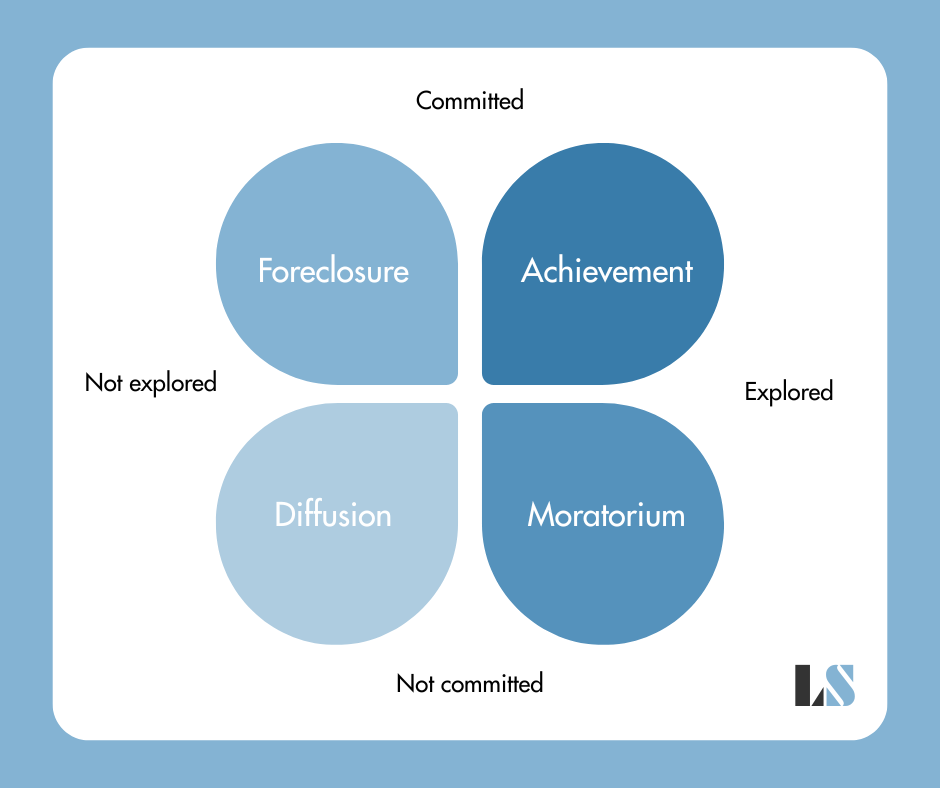
The result of this work was the identification of four statuses:
- Achievement – where the person has both explored their options and made a decision, which means they have constructed their own identity
- Foreclosure – where the person has made their choice with little to no exploration, possibly because it has been imposed by others (hence a ‘conferred’ identity)
- Moratorium – here the person is actively exploring but hasn’t yet settled on an identity – these people usually progress to Achievement
- Diffusion – finally, people in this group haven’t explored, are uncommitted, and easily swayed by others
Quick detour – The Fifth Status
Anyone who’s worked with teenagers might have picked up on the fact that there’s another group missing from the four statuses Marcia proposed – that of people who haven’t explored or formed an adult identity, but who have also decided to remain this way. Luyckx et al. (2005) called this Carefree Diffusion, which is different to the original diffusion and people in that group still want to reach Achievement at some point. People in the Carefree Diffusion group don’t reach any kind of conclusions, and are passive about their future. They found that, for many of them, they seemed to be coping quite well with their circumstances and suggest that, rather than needing more intervention they simply need some time.
I feel that their findings may be a reflection of their participants; they recruited first year university students all studying psychology or education, 85% were female, and all students were caucasian and middle-class. Another study which sampled a much larger and wider range of young people found that the Carefree Diffusion group were more likely to display aggression and break rules, drive while drunk, and take illicit drugs, all signs that they may be less ‘carefree’ than they look.
It’s easy to assume, as an outsider, that this type of status is one that’s chosen by the individual as some sort of easy way out, but I’m doubtful that that’s all there is to it. Many cultures are seeing a rise in social isolation for many young people who have left school but then seem to have stalled at life – living in their rooms, fed and housed by their families, and only connecting with the outside world through the internet. In Japan this is called hikikomori, and it’s a big problem – around 1.2% of their population is currently affected.
In many cases, voluntary social isolation is the result of a form of learned helplessness – young people struggle to take their first steps in a very difficult job market, and choose to remove themselves from the situation – no longer even trying – rather than continuing to fight against a system where they see no hope of winning.
What is learned helplessness?
This is a concept developed by Martin Seligman, often known for his work in positive psychology, back in the 1960s. It’s not nice reading, so apologies in advance and double apologies if you’re a dog lover.
Basically, they tested what would happen when they put a dog in a box and then sent an electric current through the floor of the box. To escape the shock, the dog could simply jump over a small barrier onto the other side of the box, where there was no shock running through the floor. What they found, was that dogs who had been given opportunities earlier on to learn how to escape the shocks would quickly work the barrier puzzle and escape again. Dogs who had previously been shocked with no control and no hope of stocking the shocks, on the other hand, didn’t escape even though they now could – they simply laid down on the floor and whined.
Scarily, similar experiments have been conducted across species and also in humans, and essentially, their work showed that when we have experienced trauma over which we have no control, we become passive, and I would suggest that this is what’s happening in a number of the people who would fall into the group of Carefree Diffusion, and possibly indicates that we need another name for it…
Occupational Identity
While the original statuses were technically designed to encompass ideas such as Occupational Identity, Vladimir Skorikov and Fred Vondracek took them further and looked in detail about how specifically occupational identity could develop. For example, they noted that people who had a role imposed on them by their family early in their childhood would almost inevitably fall into the Foreclosure group. Likewise, children who grow up to become professional athletes have generally been encouraged and supported in this goal, often to the exclusion of all other pathways, making their own careers inevitable (provided they are successful) – but in many cases this is what is required in order to achieve success.
Young people who grow up living in intergenerational poverty and unemployment, on the other hand, have a different battle to fight. With few societal expectations or positive role models to guide them, it’s easy to remain stuck in Diffusion, and this is why early intervention and culturally sensitive programs that connect kids with strong role models are so important.
They also point out that it’s not a smooth, continuous process, and we all tend to go through periods of exploration and/or commitment at varying levels as we move from our teen years into the workforce. Their model expands the exploration scale from the original explored/not explored into three categories: limited, active, and completed.
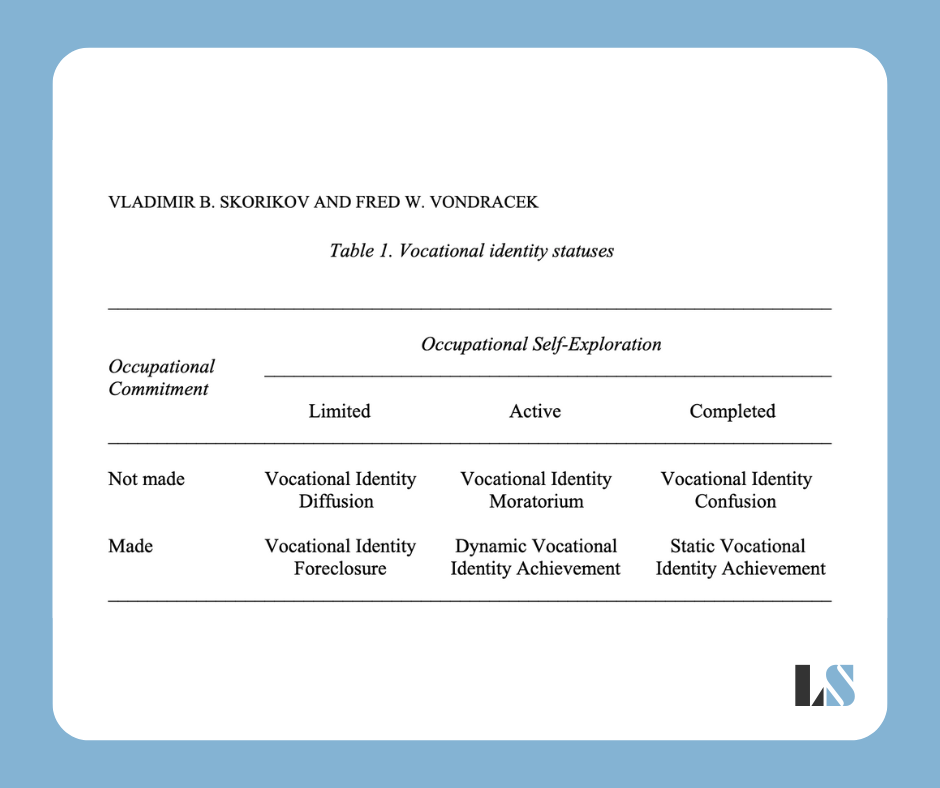
Their Vocation Identity Confusion is very similar in form to the Carefree Diffusion mentioned earlier – they haven’t made a commitment, but they’re also no longer exploring. The other key change they make is in recognising that careers aren’t set in stone, and splitting Achievement into dynamic and static categories shows how we can retain our ‘achieved’ Vocational Identity while also exploring where we could go next.
While the six status model is useful, I tend to use the original four quadrant model as I find it’s sufficient for what I need for understanding where the people I’m working with are at.
Back to the identity statuses
So where we were up to is recognising four identity statuses, while also being aware that there is variation within the statuses. Before I move into how I use them, I thought I’d give a little more detail on each of them and how I see them present with a couple of examples for each.
I mainly look for the two ‘problematic’ ones when I’m talking to people, to the point where I often forget what the official term is for Achievement, so I’ll start with a quick overview of the two ‘easy’ ones then go into a bit more detail about how I work with the other groups.
Achievement – the easiest
The easiest way to understand someone in this group is to them of them as having reached the ‘other side’ – in career development we might call this a successful transition. They know who they are and where they are going, and are not easily swayed off course.
In adults, this could look like someone who’s feeling confident and comfortable in their current career path, and if they’ve come to me for a conversation then we’ll probably be weighing up a couple of quite specific options – perhaps they’re trying to work out if now is a good time to do some more study, or they’re thinking about searching for a similar role somewhere else.
In a younger person, they could come to me with a clear and well-researched idea, and want to have a conversation about what to look for in an apprenticeship for example. With a couple of probing questions I’ll be able to identify that they’ve done their homework and they’ve generally spoken to someone in the role they’re considering, plus they might have done work experience or an internship, or had a part time job in the same field.
Generally these people don’t need a lot of counselling, per se, and the work we do together tends to focus on the practicalities of their choices. Sometimes the conversation might go a little deeper if they’re facing an unexpected career event, but even then this will just be to help them get back on track.
Moratorium – less chill but still easy
I see this space as a bit of a holding ground; people here are actively exploring their options, thinking things through, talking to others about their ideas, and occasionally trying things out. But, this is exhausting, and I find they tend to end up going one of two ways – they’ll make a decision and take some steps and head off into Achievement, or they’ll get worn out in the work and slide on over to Diffusion or Foreclosure if they’re not careful.
From a career development standpoint (and in an ideal world) this should look like organised, proactive exploration of options, supported by conversations with family, friends, educators, career development practitioners, as well as opportunities to experience a variety of possible pathways first hand. This work would, in theory, lead the young person on a journey of progressive self discovery where they eventually had enough information about themselves and their options to be able to make a decision.
But, as we all know, career development doesn’t often look like this, and even the most enthusiastic teenager may struggle to secure the experiences they feel they need to be able to make a confident decision. If this is the case, a slide into Foreclosure might look like taking a ‘good-enough’ job or falling back to the safe option. Diffusion on the other hand might look like starting any degree or delaying graduation, or taking a ‘temporary’ role that ends up becoming a lot more long term than expected.
Working with adults who are still in Moratorium is rare – generally, by the time they’ve entered the workforce they’re already in either Diffusion or Foreclosure – but it does happen. Sometimes it might be because the adult is ready to change careers, in which case I work with them on ensuring they get the experiences and information they need to be able to make an informed decision. This might look like exploring their skills and strengths, and how they translate to other industries, or it could focus on more helping them identify people in their network they could talk to next.
Working with teenagers in this group is fun, provided I have the opportunities and experiences they need to support their exploration. They’re usually positive and engaged and keen to talk about their options, so while I’ll help them in the same sort of way I work with adults I may also spend a bit of time helping them learn the skills to organise their thoughts and systematise the process, so they don’t get carried away and we reach an end-point.
As a side note, sometimes when I’m out and about I’ll need to tell someone what I do for work, and occasionally they’ll then start pelting me with questions about their own career – if this happens, I’ll know that the person is probably in Moratorium.
Foreclosure – possibly difficult
People in this group can be tricky, especially at the start, because they probably don’t want to talk much about their choices. Or, if they do, it’s about the technicalities and they don’t want to go back and reevaluate their decision.
Because they’re often aware that they’re in this group, they might be a bit defensive or feel quite fragile, so they require patience and understanding. This is especially important to recognise because in many cases they aren’t in this group entirely of their own doing; they’ve often been pushed here by circumstances or people outside of their control, and in the process of revealing their foreclosure you could inadvertently reinforce the harm that has already been done.
People in this group, regardless of their age, have fixed ideas about the work they want to do, but don’t associate their work with their identity. For adults this might look like treating their work as ‘just a job’ – a means to an end – and not a reflection of who they are. This is actually technically fine, there’s no rule that says you have to love your job, and it’s perfectly ok to take any job that pays the bills provided you can find a sense of self in other areas of your life. In younger people this might look like someone who is set on their choice but you know they don’t really know a lot about it, and perhaps you feel that their choice might not reflect their skills and strengths.
I know I’ve mentioned it before, but it’s super important to recognise that there are many, many people who have little to no choice in their occupation, whether that’s for cultural reasons, perhaps there were few jobs on offer near by, or maybe they needed to take a job that they could combine with caring responsibilities.
Why difficult?
Because we can’t assume that they need help, but we also can’t assume that they don’t need help. Let me explain:
- They may not want help – their job choice doesn’t align with their identity, but they’re ok with that, and don’t want to look at other pathways. In that case, we shouldn’t force them to explore any further.
- But, they may also need help if they don’t realise what’s happening, especially if they’re younger. It might be tempting to assume that a student who comes to us with a firm career path has done enough exploration and doesn’t need to talk through other options, but this is why we should do a little bit of extra work to identify if they actually have a good understanding of the path they’ve chosen, before we dive in to looking for universities.
How to help
- Look for underlying reasons – has their family influenced their decision? I see this all the time in young people, and often when I’m speaking to someone mid-way through a degree it’s because they’ve started on a path that was chosen for them. Also think about if their foreclosure could be a coping mechanism for dealing with anxiety; choosing a pathway is stressful, and making a firm decision that takes the conversation off the table can be a tempting path at times.
- Encourage them to acknowledge what’s happening – to be honest, you’re probably going to be up against a blank wall if you can’t get past this step. This’ll also require some strong counselling skills, so remember your positive reframing and open questions.
- Be aware of anchoring bias – they’ll probably want to compare any new options in relation to their existing choice, which can be tricky to deal with when you want them to think wider. For this reason, you might want to do some initial work on identifying their skills, strengths, and preferences before you jump into looking for alternatives, and then keep these front and centre in the conversation so the person is evaluating new ideas in relation to these, not their original choice.
How you respond to each person will be different, depending on what they need, but, if you feel that they could benefit from reopening the exploration process then I tend to follow these steps:
If you’re feeling like this might be you, the first thing you can do is acknowledge it and then seek out someone to talk to about it – perhaps a mentor or family member, or seek out a Career Development Professional for a quick chat.
Diffusion – more challenging
The last group are the ones who are going to need the most support because we need them to take ownership over their decision. Usually, if they’re in this group it’s not because they want to be, but because they’ve found themselves there;
- Perhaps they spent some time exploring in moratorium but were unable to make a decision,
- Maybe they’re too busy with work, caring for others, dealing with relationships, playing elite sport, or just handling life in general, and making career decisions isn’t even on their radar,
- They might not have a clear idea of their skills or strengths, and be unable to identify their preferences,
- Or they could have faced a big knock recently, if they’ve not been accepted into a course, or suffered an injury, for example.
Diffusion can also happen when people have gone through something that’s limited their options and this has caused them to feel that there aren’t any solutions for them. People living with a disability may find it much harder to find a workplace that suits them, through no fault of their own, and while they want to work they may literally be unable to find a path forward; people who are neurodivergent, for example, are three times as likely to be unemployed as neurotypical people.
In other words, we need to arrive at this process aware that the person will need support to move out of this group.
How to help
When working with this group we really want them to be the ones in the drivers seat, because they need to feel ownership of their idea or it’ll never really become their occupational identity – just one we imposed on them.
With that in mind, sometimes they’re not ready – and acknowledging that is ok too. They might need to go off and learn about themselves some more, resolve another issue in their lives, or simply have more time before they’re at a point where they can tackle this decision.
If they are ready, and you’ve done the ground work you need to do so that they have taken ownership, then the rest of the work is about scaffolding the process and supporting good, engaged exploration.
Scaffolding might look like breaking the decision down into smaller steps – choosing a career path is overwhelming, but by just focusing on one decision or aspect you can usually find a place to start. Sometimes, if I’m working with someone in this group I’ll put the actual ‘career’ conversation entirely to one side and just ask them to talk about the most immediate decision they need to make. Usually there’s a short term and relatively low-impact decision they can make which gets the ball rolling – for example, they could choose which university open days they want to attend, or decide if they’re going to enrol in a short course or not.
You can also scaffold the conversation by learning more about their strengths and skills before you start looking at careers. You could review their resume if they have one, or talk about their favourite jobs or tasks – anything that’s easy for them to think about and shifts the pressure away from ‘which job’.
We also want to encourage good exploration, and to start with they might need quite a bit of help to do this, so don’t assume they will know what to do on their own.
Wrapping it all up
The beauty of using identity statuses in career development work is that it gives us a framework for understanding not just what someone is thinking about their career, but how they’re thinking about it. Rather than treating every career conversation the same way, we can tailor our approach to meet people exactly where they are in their journey.
If you’re working with others – whether as a career counsellor, educator, parent, or mentor – I’d encourage you to listen for clues about which status someone might be in before diving into solutions. Someone in Achievement probably just needs practical support to execute their plan, whilst someone in Diffusion might need help identifying their first small step. The person in Foreclosure may need gentle questioning to help them recognise whether their choice truly reflects their own exploration, and the individual in Moratorium likely needs structure and support to work through their options systematically.
It’s also worth remembering that these statuses aren’t permanent labels; they’re snapshots of where someone is right now. People move between them as their circumstances change, as they gain new experiences, or as they face unexpected challenges. The young person who was confidently in Achievement at 18 might find themselves back in Moratorium at 25 when their industry changes, or the adult who was stuck in Diffusion might move into active exploration when they finally have the support they need.
If you’re reading this because you’re trying to work out your own career direction, take heart in knowing that wherever you are in this process is perfectly normal. There’s no shame in being uncertain, no rush to have everything figured out, and no requirement to stick with a choice that no longer serves you. What matters is being honest about where you are and getting the right kind of support for that stage of your journey.