Finding a Common Language for Skills
· Thoughts
🎧 Listen to this article
Heads up: this isn’t actually my voice - it’s an AI-generated voice, made on a local model running on my own Mac. It’s not perfect, but hopefully it’s a warmer, more me listen than a screen reader for anyone who’d rather hear this than read it.
Yesterday I attended the first webinar from Jobs and Skills Australia (JSA) on their new National Skills Taxonomy (NST), led by Megan Lilly. You can read the accompanying think-piece here if you missed it. It was a fascinating insight into their development processes - I was involved in the consultation panels last year when they started out, and it’s great to see how far they’ve come and just how much time and effort (and probably money) has gone into creating a definition of skill as a concept.
It’s vitally important that they do this work, because the way they choose to define skill will shape the infrastructure they end up building. For example, taxonomies which define skill as a flat concept - as in, they don’t specify as something that can be acquired or developed - tend to have flat, short lists of core skills, which are separate from the technical skill lists, while taxonomies that define skill as something that is learned, built, acquired tend to separate core skills that are outward facing (like communication, collaboration) from skills which are inward-facing or directed at the self (like resilience, initiative, creativity).
I’ve (fingers crossed) got a paper on this coming out soon so will explain more then, but we can see this at play in the definition which JSA have come up with for the new NST:
A skill is a valued and purpose-driven human ability that is acquired or refined through learning and practice. It is a dynamic function of an individual’s knowledge, experience, and personal attributes that is continuously influenced by context, interaction with others, and the demands of the environment in which it is exercised.
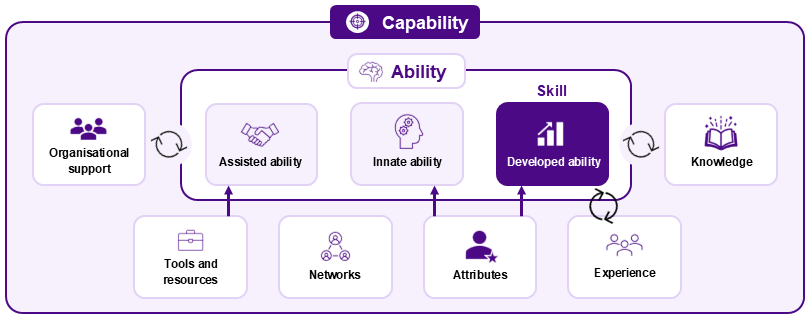
They visualise this in practice with this great dynamic diagram which reminds me a little of the Systems Theory Framework diagram:
A purple graphic which shows capability as the outer layer, then with this is ability (further divided into assisted, innate, and developed abilities), and various ecosystem factors. Source: Jobs and Skills Australia
From this, I expect that we’ll see a taxonomy that holds technical skills (developed abilities) in one bucket, and splits core skills into the more technical-ish ones (and probably stores them in developed ability), and ones that could be considered innate abilities or attributes.
The definition itself is strong and specific; linked directly to humanity, and including mechanisms for development and refinement. I love that they’ve recognised that skills, while being valued and positioned within this infrastructure as economic units, are also dynamic and influenced by their ecosystem. But the definition does raise some questions, such as, if skills are restricted to human abilities, what does this mean for machines who can perform the same function? Can a piece of technology no longer hold a skill? Is the same action performed by and human vs. a machine a skill in one context and something else in another? To be clear, I don’t have the answers to these or my other questions, but it’s something I’d like to see clarity on in the framework. What about working dogs who learn to detect drugs being brought into airports, do they build skill, or are their abilities simply ‘tricks’?
The way we define skill as a concept underpins the entire taxonomy, but in this article I wanted to look closer at something else all taxonomies I’ve reviewed seem to have in common, which is a stated aim of building a ‘common language of skill’.
A common language of skill?
Now, this sounds like a great thing - surely if everyone is so keen to build a common language, we should be able to find consensus, right? Ah, no. To prove my point, these are the stated aims for the world’s current, open, major skills taxonomies:
From the granddaddy of skills taxonomies - O*NET’s predecessor DOT (the Dictionary of Occupational Titles):
…the DOT should serve as a national benchmark that provides a common language for all users of occupational information.
and from O*NET itself, back in the early days:
…person-job matching might be explicitly linked to training recommendations bearing on the training or development of requisite skills. If the occupational information system is to integrate responses to diverse queries, two requirements must be met. First, descriptors must be phrased so that they are readily understandable by users with different backgrounds and different concerns. Second, the descriptors must provide a common language that will permit users with different backgrounds and concerns to integrate and interrelate their efforts.
and in the ESCO (European Skills, Competences, Qualifications and Occupations) they talk about:
The aim of ESCO is to support job mobility across Europe and therefore a more integrated and efficient labour market, by offering a “common language” on occupations and skills that can be used by different stakeholders on employment and education and training topics.
while in the World Economic Forum’s Global Skills Taxonomy:
The following proposed framework for a global skills taxonomy is a first step in shifting toward a skills-based labour market. We hope that the principles for implementation herein will serve to further align learning supply and demand around a common language for skills and unlock the Reskilling Revolution.
and the UK, who recently built out the Standard Skills Classification (SSC) phrase it this way:
The SSC provides a coherent framework and a common language for describing the skills, tasks, and knowledge required across the labour market.
Canada kind of let me down just a little, they don’t use the phrase ‘common language’ explicitly, instead they describe it in the Skills and Competencies Taxonomy (SCT) this way:
…the SCT was created to address discrepancies in terminology used across different data sources in the Canadian labour market, thereby providing a common competency dictionary.
Meanwhile, here in Australia we’ve doubled down on ‘common language’, first in the now-defunct Australian Skills Classification (ASC):
It maps the skills used within occupations, providing a ‘common language’ of skills where things like occupation titles and qualifications have long been used as proxies.
and now in the new NST:
The National Skills Taxonomy (NST) is a new, evidence-based framework that provides a common language for describing the skills Australians gain, develop, and use across education and employment.
Other than the recalcitrant Canadian SCT, which just had to be different (albeit not that different) we’ve got a lot of important people saying that the point of a skills taxonomy is to create one common language.
So how come we have ended up with this many different ‘common’ languages? They don’t all use the same definition of skill, or the same list of skills, or structure of taxonomy, or even call the same skills the same name! It’s not one common language that they’ve created, but rather a stack of individual, localised, owned languages which need translating in order to speak to each other.
I have questions…
If you’ve been following along with my skills project then some of this might seem familiar; I am, after all, just about finished building a mapping tool that translates terms from one skill framework into another, but wouldn’t it be lovely if I hadn’t needed to do any of this?
It’s got me thinking about what a common language actually is.
What is it that makes a language common, and do we all really want to be speaking the same language all the time anyway? There are a lot of people all claiming to be developing a common language of skills, so I figure it’s probably a good idea to ask some of these questions and don’t just take it for granted that we’re actually building a common language, or that a common language is even a good thing.
If we’re able to define skill as a concept at the core of out taxonomies, then perhaps we also need to reflect on how we define a common language, and if building a common language is even something we really should be doing.
What is a common language and how would it help?
When we talk about a common language, what we really mean is that we want to build a way for everyone to communicate together and mean the same thing - and it is the shared meaning that is the real goal. There are three types of common language:
Lingua Franca
This is what we call a ‘bridge language’ and it exists so that people who don’t share a language can communicate. In centuries gone by, these would be languages primarily used for trade, which were used to help move goods across communities. Sometimes these take the form of a ‘global’ language - like English, which is often used in areas frequented by tourists (see the Osaka Station sign below for an example), or a pidgin or creole which is where two or more languages are combined, usually in a simplified way.
English performing as a Lingua Franca in Osaka, Japan
Shared Technical Vocabulary
Within some fields, usually where there’s a highly specialised level of technical knowledge, a shared technical vocabulary may be developed. These are usually formalised and standardised ontologies, such as SNOMED CT which was designed to be an international clinical terminology for health systems, and has been adopted across the globe. But they don’t have to be formal vocabularies, sometimes these emerge through shared communication within a kind of linguistic bubble, such as speaking ‘Silicon Valley’ or ‘legalese’.
Common Ground
This one is the least formal of the three, and describes a situation where people can communicate through differences based on a shared set of agreements or beliefs. If you can’t find common ground, then it’s difficult to conduct a conversation (even if you’re speaking in the same language) but when you share knowledge, aims, and values then you can form a common language.
Skill taxonomies are designed to be shared technical vocabulary
But in order for these to really work across and between systems, then we really need to have only one to work from. That’s why SNOMED CT works, and has created a truly common language, when the various skill taxonomies haven’t. The not-for-profit which maintains and manages it is owned and governed by member countries, which means their efforts can focus on creating one unified ontology.
Perhaps, if a group of countries could come together we could work towards a similar shared approach for a skills taxonomy, but that brings me to my second question; is a common language even a good idea? Surely it is for medicine, where we’re talking about discrete medical concepts with a singular meaning, but skill and occupations are rarely identical.
Is a common language a good idea?
If you’ve read (or watched, or listened to) Douglas Adams’ great text, The Hitchhiker’s Guide to the Galaxy then you may remember the babel fish. The babel fish was inserted in your ear (ew) and allows you to instantly understand any language - very handy for travelling across the galaxy. Image below of the TV version of the babel fish:
The anatomy of the babel fish
The name of the fish comes from the Bible story about the Tower of Babel, a mythical city where everyone could understand each other, and I don’t remember how it ended because I’ve forgotten most of Sunday School but I don’t think it went well for the citizens of babel.
In the Hitchhiker’s Guide to the Galaxy, people still retained, spoke, and heard their own language, but in Babel they all shared a single language - and that is the differentiation I want to make here.
There are ways to allow people to communicate without losing their own language. Indeed, in an age where Google can translate just about anything in the blink of an eye (including rare and precious Indigenous languages), it is theoretically possible that we have now developed our own babel fish for languages, and lingua franca may end up becoming a thing of the past.
Which would probably not be a bad thing.
When we talk about a ‘common’ language, we can really replace ‘common’ with ‘dominant’. That’s because the people who are in power get to decide the shape of the common language, and all to often that resembles the language spoken by the people in power. Case in point: the erasure of First Nations languages from Australia.
The National Archives of Australia have an excellent set of resources for learning senior history on the dispossession of Indigenous languages - before the British colonised Australia, people here spoke over 250 languages and 800 dialects, but this number is now down to 123. The multitude of languages was replaced (often forcibly) by the ‘common’ (and dominant) English language.
I’m not suggesting that the developers of our skills taxonomies are undertaking oppression at anything like this scale, but the question of ‘what will be left behind’ in creating a common language needs to be asked.
Will skills developed and used mainly in domestic settings make their way into the NST? Will skills refined for millenia by the First People of Australia be correctly captured, named (with allowance for regional differences in title), and classified? Or will the NST mostly be composed of visible occupational skills, with clear economic value?
Silences are already present within our occupational systems, and these are often used as as the starting point for the development of the skills taxonomy. For example, in Australia, ours is the OSCA and while the developers took steps to fill some of the gaps, for example by splitting one occupation which had represented 5.3% (!) of the Australian workforce into five occupations, there are still a whole lot of jobs not adequately represented or simply not defined at the same level. If a truly common language is the goal, then these silences need to be considered at the start of development.
My final argument for considering a translation mechanism, rather than one common language, comes from the fact that when you choose one language over another you lose the nuance which makes language so brilliant. I speak English, but I know that there are concepts in other languages that I yearn for. Take, for example, Bildung - a German concept that has no direct translation into English. If you speak German then please feel free to correct my interpretation, but my understanding is that it is a process of personal growth and development, and the shaping of character through both education and life. As another example, the Sámi people from the Arctic have more than 200 words to describe snow - whereas I’m limited to ‘snow’ and ‘sleet’. Sure, I might go ten years or more without seeing snow, and 200 words are probably not much use to me, but I don’t dispute the right of the Sámi people to their diversity of vocabulary, and I shouldn’t force them to confine themselves to my two meagre words for the sake of a common language.
Out of all of the skill taxonomies I’ve reviewed, I’m not surprised that the EU are the people who have found a solution which respects this wonderful diversity of language, and their model is one which could be easily adopted by other developers. Rather than limit themselves to a single term for each skill, they have one preferred term, then additional non-preferred terms, as well as hidden terms, and they do this in each of the 28 ESCO languages. Take Communication, for example:
-
Preferred term: communication
-
Alternative labels: correspondence, interaction, communicating, and conversation
-
Hidden labels: these will be alternative spellings etc.
-
Description: Exchanging and conveying information, ideas, concepts, thoughts, and feelings through the use of a shared system of words, signs, and semiotic rules via a medium.
The additional labels give us more context, and allow people to use the terms they prefer yet keep them on the same page.
Will we find a common language?
I don’t know. Possibly, in time, and we may end up with a flexible shared technical language that acts as a living catalog of skill in all its forms and dialects. Or we may end up with more crosswalks and translation mechanisms for a set of discrete common languages that work well within their own contexts.
I’m hoping for the first, while working on tools that facilitate the second. At the end of the day, all that really matters is that young people can describe the things they do well in a way that works for them, and I’m open to any developments that support that process.