Ebbs and Flows
· Thoughts

🎧 Listen to this article
Heads up: this isn’t actually my voice — I don’t have an English accent! It’s an AI-generated voice, made on a local model running on my own Mac (powered by solar, so no data centres were built on my behalf). It’s not perfect, but hopefully it’s a warmer, more me listen than a screen reader for anyone who’d rather hear this than read it.
Three years ago I set out to start a little newsletter which gave me a space to collect and share my thoughts and ideas. Back then, I had no real idea what my plan was, I just wanted to write, and my first edition came out in May 2023. Now, I’m almost up to 100 editions and 3000 subscribers, which is probably further than I ever thought it would go.
Back when I started writing I took my own advice for trying anything new in the social media space, and enjoyed the initial period of very low readership numbers while I worked out what I wanted to say and how I wanted to say it. I’ve found that there’s always a blissful period between when you start doing something and when people actually twig that you’re doing something – which gives you a safe space to experiment and be brave without getting too caught up in what other people think.
Fast forward three years, and my energy for Pondering Careers now ebbs and flows.
I enjoy the deep dives into complex topics, hearing other voices in response to mine (I’ve always preferred a choir to a solo gig) and the feeling that I can add value and be useful. Be Useful has been a motto of mine since I read Arnie’s book, coincidentally at about the same time I was starting this newsletter, and it’s served me well because being useful gives my newsletter a focus.
But, for all that I love about the writing, there are things I find less fun. I don’t enjoy the pressure, the ticking two-week clock that starts as soon as I publish, reminding me that another is due before we know it. I don’t enjoy that I worry so much about what people will think of my writing – will they wonder if I use AI? Will they think I’m overstepping my subject area? Will they find me boring, or worse, irrelevant? And those feelings have slowly begun to strip away my love for writing in-and-of-itself, to the point where I tell myself it’s ok not to write at all, that no one is really listening, that LinkedIn no longer cares for newsletters, and perhaps it’s time to try something new.
Boo hoo.
Sob-fest aside, this is my way of owning that I’ve been avoiding writing for a while now, and taking steps back towards the place I started, and what brought me here in the first place. At the same time, this gives us all a chance to think about how life ebbs and flows; how things that work for one period of our lives may not fit into another.
Change is constant – we change, the world around us changes, our situation changes, and just because something worked well at one point, there’s no guarantee it will continue to do so.
This shows up particularly in our careers. The work you do will consume a considerable portion of your energy and focus, but the energy we bring to it is not always consistent – at times we might be highly motivated and seek out challenging work, while at other times we need more balance and less pressure, and careers need to be elastic enough to go with the flow.
The Kaleidoscope Career model is a great theoretical model for understanding how this works in practice. Developed by Lisa Mainiero and Sherry Sullivan, the model uses the kaleidoscope as a metaphor for the way the pieces of our lives shift and turn over time into new arrangements:
Like a kaleidoscope that produces changing patterns when the tube is rotated and its glass chips fall into new arrangements, women shift the pattern of their careers by rotating different aspects of their lives to arrange their roles and relationships in new ways.
Throughout a career, different questions dominate the decision making process:
- Authenticity: Can I be myself in the midst of all of this and still be authentic?
- Balance: If I make this career decision, can I balance the parts of my life well so that there can be a coherent whole?
- Challenge: Will I be sufficiently challenged if I accept this career option?
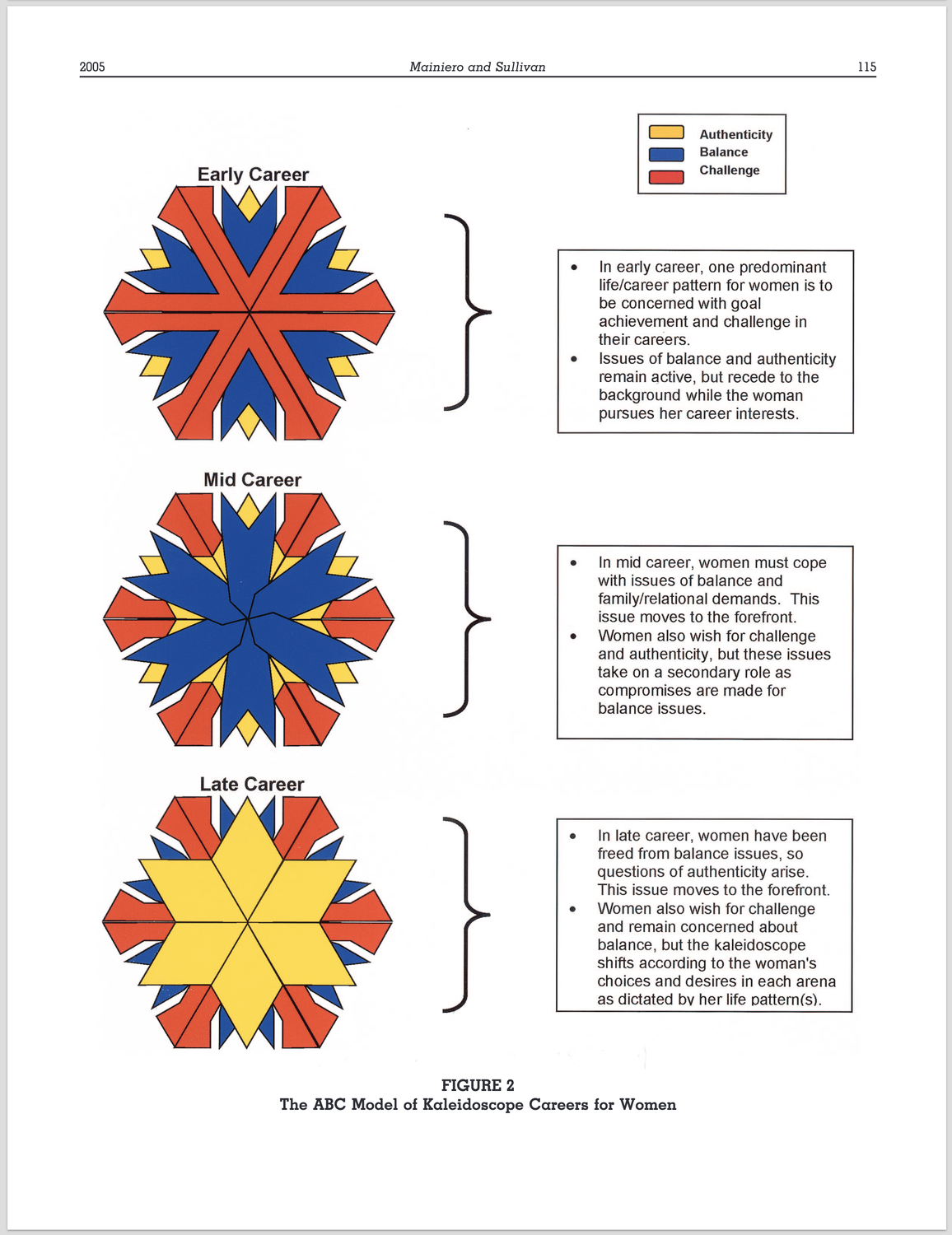
Which gives us a neat ‘ABC’ of careers. At times, we’re looking for work that reflects how we see ourselves (authenticity), while during other phases we might be looking for balance, especially if we’re juggling multiple competing priorities (balance), but there are also periods where we might prioritise taking on bigger projects and new challenges that push us outside of our comfort zone (challenge).
In thinking about my own ebbs and flows, I’ve been thinking back about where my kaleidoscope is currently resting. When I started writing Pondering Careers I was in a very different place. I had less outlets for writing that weren’t tied in to Study Work Grow – which meant I didn’t have a place to workshop my ponderings that were not secondary-school flavoured (authenticity + challenge). The kids were younger, which meant I still had to make them lunch, but they didn’t do as much stuff so there were less interruptions in my workday (balance). In other words, I was looking for authenticity and challenge, but not quite so worried about balance. Now, SWG has grown, I’m part way through my PhD, the kids need driving everywhere, and my appetite for waking at 4am to write a newsletter has waned. I’ve got other outlets for writing, the newsletter feels a bit less like proper challenge and more like a never-ending battle with the LinkedIn algorithm, so my kaleidoscope has shifted, as has the newsletter’s place in it.
Now what I think I need is something more like the Visual Journals I used to keep while I was working as an artist, an outlet for raw ideas and workshopping thoughts before they make it into a more serious form. Space to play and write more organically, with less proofreading and zero requirement to run it through AI to ‘improve’ (ie. bland-ify) it.
A trick many artists use when they want to improve is to draw without an eraser or using pen – in committing to the work and remove the option to back out or second guess their choices, you end up trusting your lines. I’m thinking that this could become the same for me.
Which is, I guess, a form of warning to the reader. If you are here for polished thoughts only, or honed prose free of mistakes then perhaps this isn’t the place for you. There may well be more rambling, more self-reflection, more writing written for the author, not the reader, so perhaps this is the final time you’ll be here. But if you can handle fluidity, then I’m hoping that in return I can offer the same rigour I’ve always brought to my work – deep research, hallucination free ideas, and critically selected sources. Alongside sits a constant invitation for peer review in all forms – comments, questions, critiques, are all welcome, and will hopefully continue to enrich the conversation.
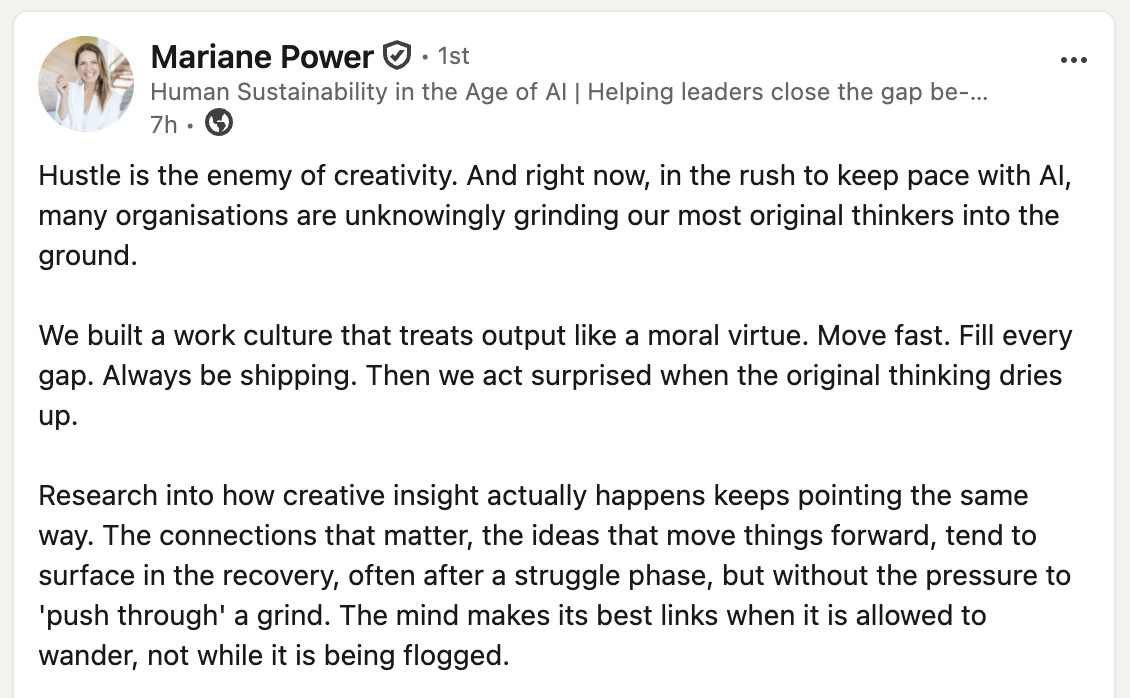
Mariane Power posted this morning that “hustle is the enemy of creativity” and that “the mind makes its best links when it is allowed to wander” and in returning to a form of written journal that lives out in the open I hope that letting my own mind wander will result in better, bigger, deeper ideas for me to share and us to discuss.
One of the side benefits of this decision to go back to the original purpose of the writing is that I can worry less about which topics will please the algorithm and allow my hyperfixation to roam as it pleases, choosing topics I really want to write about. This isn’t to say I’ve often written about things I didn’t care about, but there have certainly been times when I’ve parked a 90% completed edition because I wasn’t sure if it would be well received. I’ll still be writing about skills and work, but want to give myself freedom to be a normal, complex human, and interested in more than just my tiny niche.
I have an insatiable need to know stuff – which means I love learning, but the process of writing forces me to do a few things which take ideas further than they would perhaps go otherwise. These things look like:
- Defining my idea from a vague thought (like the ones that crop up while I’m running, or in the shower) into an actual hypothesis or question. It’s very difficult to write a couple of thousand words off the top of your head without a guiding question which sets the parameters and also helps me work out when I’m ‘done’
- Conducting actual research and checking sources – I kind of do this for general thoughts, but I find that I go much deeper when I’m writing the newsletter because I like to give people ways to go further than just what I think.
- Working out how to turn all this into a format other people could also absorb. This is genuinely one of the hardest parts of writing – how do I take the things I have learnt and scaffold them into a format that another person can digest and understand?
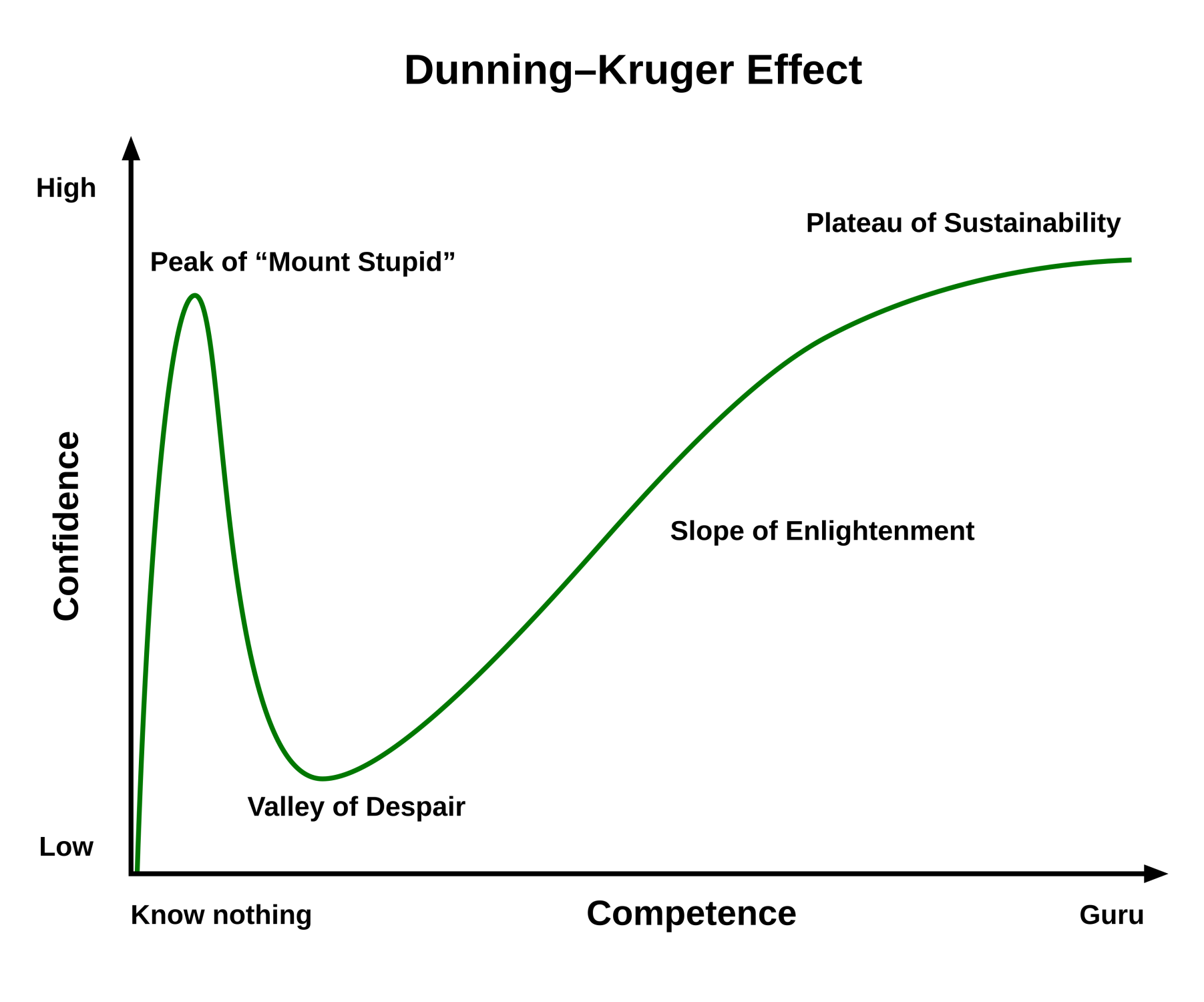
- Finally, writing like this forces me to refine my original idea. It’s super easy to live in a perpetual state of Dunning Kruger Effect, resting on the peak of Mount Stupid after just a little bit of research, but when I’m writing it naturally forces me off the top and into the Valley of Despair at which point I can slowly trek the slope of enlightenment.
Finally, if I’ve learnt anything from this all-consuming Skills Project I’ve been working on since Easter (watch the most recent update below), it’s that it’s ok to let myself go deep sometimes, provided I can always return to the surface.
Once upon a time, I used to dream of living in a world where I had the freedom to focus deeply on just one task all day, without having to worry about pesky things like the accounting, or marketing, or working out what was for dinner. This Skills Project has been the first time that I’ve really been able to allow myself to go deep – and it’s only been possible because of my incredible team who are doing all those other things so brilliantly that they no longer really need me very often (or at all…).
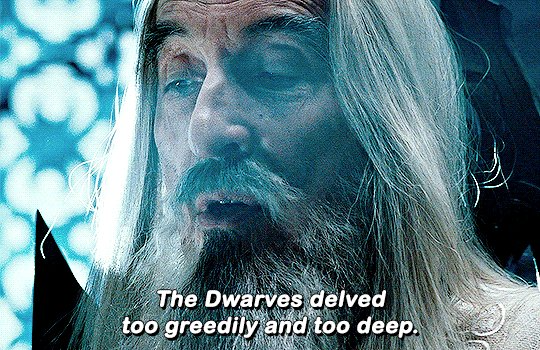
But going deep has its costs, as Saruman would remind us, and one of those has been that it’s very difficult to drag myself back up to the world to do things like write a newsletter.
Which brings me back to ebbs and flows. I’ve always lived by the rule that consistency is key, but in going deep into projects that require so much of my brain power I’ve realised that it’s ok to sometimes let the consistency slide a little. In reclaiming Pondering Careers, I’m also acknowledging that there may be times when I write voraciously, while at others I may slide out of view for a while, but which part of the cycle I’m in, I hope you are along for the ride.
Lucy.