Can we stop saying that tasks = skills, please?
· Thoughts
🎧 Listen to this article
Heads up: this isn’t actually my voice - it’s an AI-generated voice, made on a local model running on my own Mac. It’s not perfect, but hopefully it’s a warmer, more me listen than a screen reader for anyone who’d rather hear this than read it.
Rant incoming.
Anthropic, who I’m normally quite a fan of, have just released new Scenarios for our Economic Futures, and I have thoughts. Their purpose was to create an economic model for “for assessing the economic consequences of AI between 2026 and 2030”.
There’s a Technical Report if you would like more of the details, but don’t expect a detailed methodology as this is a ‘calibrated simulation’ not an empirical study, and, as they say,
The framework is based on a standard task-based model of the economy in which AI can automate or augment a growing fraction of the tasks performed by labor.
Which is a lovely neat way for them to try to make sense of the colossal impact of AI on the workforce and economy by distilling it down to tasks.
Which brings me to the point of this rant/article: Can we please stop saying that jobs can be broken down into parts (ie. tasks) and then analysed without context?
Jobs are simply more than the sum of their parts. Tasks don’t work as a good proxy for skills (more on this in a minute) and they can’t be bundled up into a package and handed out as ‘careers’ in a complete way. Take your own job, for example - if you were asked to write down all the tasks you complete in a normal week, would your list encompass everything that your job requires? Would it showcase all the skills you need to do your job? My list certainly wouldn’t.
If I listed my tasks they would include writing regular articles for a network of peers - but the skills I use to write my articles are different from those Chris Webb uses to write his excellent #TheWeekInCareers articles. In his most recent article he also tackled some of the issues surrounding various attempts to break skills into palatable chunks, and it’s well worth a companion read. Chris uses different skills to me - he collects data on his topics over a period of time, invites others to write alongside him, and does a host of other things that I don’t do in writing my articles. So it’s not enough to simply say that because we both write an article we are utilising the exact same set of skills to do so.
The problem is that for a very long time (since they started building O*NET) the process for understanding jobs, and the skills required to do them, has relied on asking people about the tasks they perform. Most of the work being done in this space is done by O*NET on an American population, and this is what they have used as a basis for the Anthropic work (although the precise method is not clear on ‘how’ they’ve used it). This is from the 2024 O*NET Data Collection Program, Supporting Statement B, section 2.1:
Task Questionnaires are developed initially through the extraction of task information from multiple sources located on the Internet. This questionnaire includes a definition of the occupation and a list of tasks, for which the respondent is instructed to indicate whether or not each task is relevant to his or her occupation and to rate each relevant task’s Frequency and Importance. Additionally, space for the respondent to write in additional relevant tasks is also provided. In subsequent updating efforts, task inventories are revised to reflect the new and most current information, including any relevant write-in tasks.
To summarise, this is the process:
-
People at O*NET find tasks from the internet (presumably job ads, but this isn’t specified)
-
People say if the list of tasks for their job is relevant or not
-
They can add extra tasks if they feel theirs aren’t represented
But, as I wrote about in my recently published paper for GILE Journal of Skills Development - GJSD - “What counts as a skill? Comparing eight major skills taxonomies” - the O*NET lists of tasks have been co-opted by other taxonomies as stand-ins for skills. Tasks have become the standard when it comes to understanding and classifying skills, even though they are not a direct proxy.
Instead, I’ve started to treat careers as Complex Adaptive Systems (CAS). Systems theories are probably quite familiar to those in the career space, and the CAS work extends these to give us a model to visualise systems that are made of many parts, each following their own rules and interacting locally, changing their behaviour in response to the actions of the other parts. No one part controls the whole, and something emerges when all the parts work together which is greater than the sum-of-the-parts alone.
The consequences for research which tries to understand careers is that you can’t simply break a job down into it’s parts and expect to understand how this works. Sure, this is a super neat trick for economists who want to be able to be confidently wrong while predicting mass disruption to the labour market, but that doesn’t make the trick valid. If we want to understand how people work, and the impact that AI (or any other disruption to the workforce) may have then we need to take a wider picture.
In response to Anthropic’s Economic Scenarios, I’m going to close this early morning article (the sun has come up as I’ve been writing) with a little thought experiment which mirrors their own.
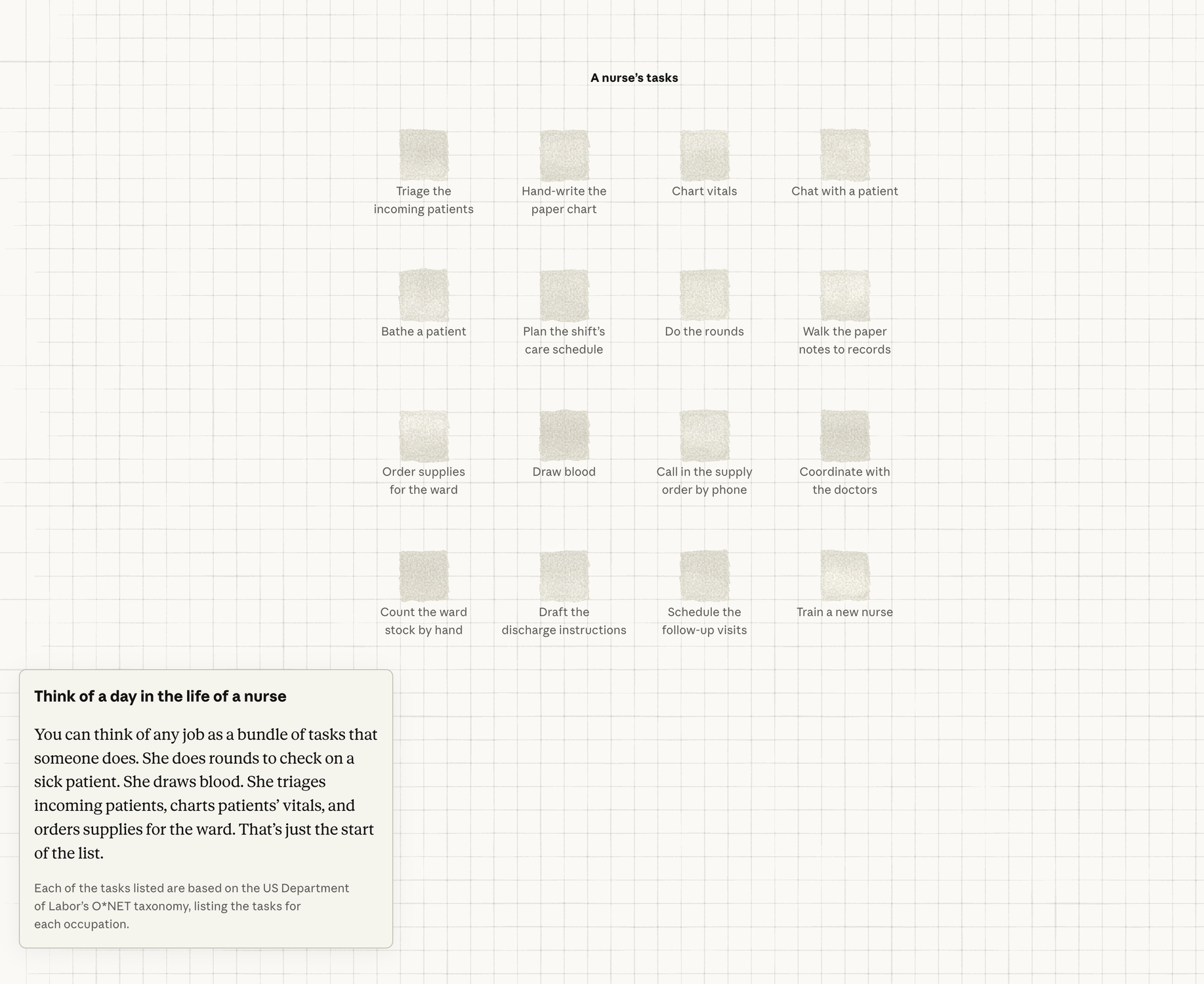
Take the career of a nurse, which is the example they use in their flashy Economic Scenarios site. Anthropic suggests that you can break the work of a nurse into just 16 tasks (yes, they really said that), and these tasks include chatting with patients (like they’re at the coffee shop?), ordering supplies (think the ward manager might have opinions about that), and the super useful ‘do the rounds’.
Where do these tasks come from? Well, there is one small note (which you can just see in the image) that says that these tasks are based on O*NET tasks, but there’s nothing further about where these tasks come from in their Technical Report, and these tasks don’t mirror what’s currently in the list for a Registered Nurse in O*NET. I have a feeling Claude may have helped draft them…
In their scenario, they go to explain how the tasks change over time, and that new tasks emerge, then create new hypothetical tasks which AI could handle entirely and then redistribute time to other tasks. Ironically, one of the tasks which is most likely to be automated by AI and/or not done by a nurse in the first place - ordering supplies for the ward - is one of the tasks which is now allocated more time under Anthropic’s hypothetical scenario, while the physical tasks which are often rushed, such as drawing blood, bathing patients, and training new nurses, keep their original time allocation.
In my thought experiment, I want to ask you to imagine you took a person who is not a nurse - perhaps a librarian, or an electrical engineer, or your local MP - and asked them to perform these tasks. Perhaps they get a little bit of training first, particularly for things like drawing blood, and we’ll skip the bit where they train new nurses, but in general we can assume that someone else could probably handle these tasks, if that was all they had to do.
Does that make them a nurse? No. Because nurses are more than the sum of their parts, or, in this case, more than the sum of a very inadequate task list. Nurses are patient (most of the time) and methodical and observant and brave. They have a vast range of skills, but no two nurses do their job the exact same way, and that’s a good thing, but it means that there’s no way to extract a clean list of skills they hold that applied to all nurses, and looking at their tasks is not a stand-in.
The sun is up and I need to go hustle some teenagers, so this is where my rant ends for today. This has got me thinking about the way this kind of AI-impact analysis is leading, and how we should interpret these kinds of publications, which look official and very visually impressive, while lacking the type of critical thinking we’re being told we will need to survive the impending AI apocalypse.